

In-Vitro Propagation vs Traditional Nursery Methods in Richmond
The Future of High-Quality Plant Production in Richmond
Richmond, British Columbia, has become a significant hub for modern horticulture and commercial plant production. Growers in the region constantly look for ways to improve plant quality, reduce disease risks, and increase production efficiency. Two major propagation approaches dominate the industry today: traditional nursery methods and advanced in-vitro propagation techniques.
While traditional nurseries have supported the horticulture sector for decades, modern laboratories now offer a more controlled and reliable way to produce clean, uniform plants at scale. Understanding the differences between these two methods can help growers, nurseries, and agricultural businesses choose the right propagation approach for their needs.
In this blog, we will explore how in-vitro propagation in Richmond compares with conventional nursery techniques and why many professional growers are shifting toward laboratory-based plant production.
What is In-Vitro Propagation?
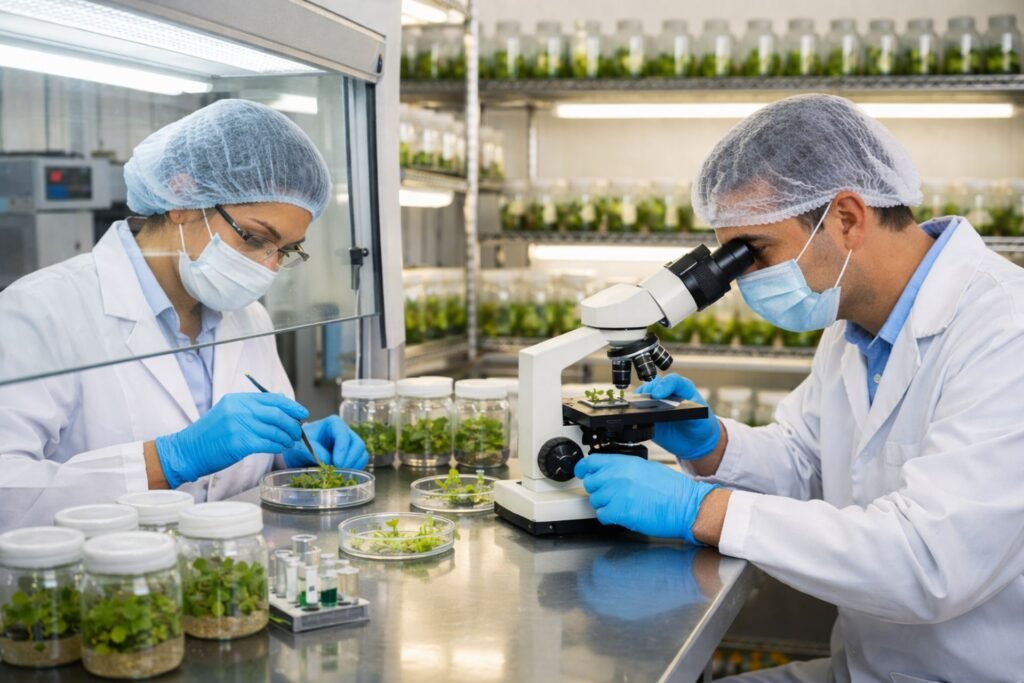
In-vitro propagation is a modern horticultural technique that allows plants to grow in a sterile laboratory environment using nutrient-rich culture media. Skilled technicians carefully place plant tissue into controlled conditions where it multiplies rapidly and develops into healthy young plants.
Unlike outdoor or greenhouse propagation, this method takes place inside specialized laboratories where temperature, light, nutrients, and sterility are carefully monitored.
The benefits of in-vitro propagation include:
-
Disease-free plant production
-
Consistent genetic quality
-
Faster multiplication rates
-
Year-round propagation regardless of weather
-
Efficient scaling for commercial growers
Because of these advantages, many professional nurseries and commercial farms across British Columbia are integrating laboratory propagation into their production systems.
Understanding Traditional Nursery Propagation
Traditional nursery methods involve techniques such as cuttings, layering, grafting, and seed propagation. These methods have been used for generations and remain valuable in certain horticultural applications.
Nurseries typically grow plants in soil or substrate under greenhouse or outdoor conditions. Skilled growers monitor watering, fertilization, and pest management to ensure healthy development.
However, traditional propagation also presents several limitations:
-
Higher risk of pests and diseases
-
Slower multiplication rates
-
Variability in plant quality
-
Seasonal production limitations
-
Greater space requirements
While experienced growers can produce excellent results using conventional methods, maintaining consistency across large volumes of plants can be challenging.
Key Differences Between In-Vitro Propagation and Traditional Nursery Methods
Understanding how these two approaches compare can help growers make informed decisions.
1. Clean and Disease-Free Production
One of the most significant advantages of in-vitro propagation in Richmond is the sterile laboratory environment.
In traditional nurseries, plants are exposed to soil-borne pathogens, insects, and environmental stress. Even with careful management, contamination risks remain.
Laboratory propagation minimizes these risks because:
-
Cultures are handled under sterile conditions
-
Equipment and media are sanitized
-
Contaminants are carefully controlled
This results in cleaner plant material, which is especially valuable for commercial growers.
2. Consistency and Uniform Growth
Uniformity is critical for commercial agriculture and landscaping projects.
In traditional nurseries, variations in soil conditions, light exposure, and environmental factors can cause differences in growth rates and plant quality.
In-vitro propagation solves this challenge by producing plants under controlled laboratory conditions. Each plant develops from carefully selected parent material, ensuring consistent growth patterns and genetic stability.
This uniformity benefits growers who require predictable crop performance and consistent yields.
3. Faster Multiplication Rates
Traditional propagation methods can take months or even years to produce large numbers of plants.
Laboratory propagation dramatically accelerates the multiplication process. Small pieces of plant tissue can multiply rapidly in controlled environments, producing large quantities of young plants within a shorter timeframe.
For commercial growers in Richmond and surrounding regions, this efficiency supports faster expansion and improved supply reliability.
4. Space Efficiency
Traditional nurseries require large greenhouse areas or outdoor fields to propagate and grow plants.
In contrast, in-vitro propagation laboratories use compact growth rooms with shelving systems that maximize vertical space. Thousands of plants can grow within a relatively small laboratory area.
This efficient use of space makes laboratory propagation an attractive option for modern horticultural operations in urban and high-density agricultural regions like Richmond.
5. Year-Round Production
Outdoor and greenhouse nurseries often depend on seasonal cycles. Temperature changes, daylight variations, and weather conditions can limit propagation periods.
Laboratory propagation removes these limitations.
Because environmental factors such as light, humidity, and temperature are fully controlled, plants can be propagated throughout the year. This allows growers to maintain a consistent supply regardless of seasonal conditions.
Why Richmond Growers Are Adopting Laboratory Propagation
Richmond’s agricultural sector continues to evolve as growers adopt modern technologies to improve efficiency and sustainability.
Many horticultural businesses now recognize the benefits of integrating laboratory propagation into their production systems.
Key reasons include:
-
Reliable disease-free plant material
-
Faster expansion of new varieties
-
Improved crop uniformity
-
Reduced production risks
-
Consistent supply for commercial demand
As the demand for high-quality plants grows across British Columbia and Canada, laboratory propagation offers a powerful solution for professional growers.
Combining Both Propagation Methods
While laboratory propagation offers numerous advantages, traditional nursery practices still play an important role.
In many cases, the most efficient approach involves combining both methods.
A typical workflow may include:
-
Producing clean starter plants in a laboratory
-
Transferring them to greenhouse environments
-
Growing them to maturity in nursery conditions
This integrated approach allows growers to benefit from the precision of laboratory propagation while still using traditional nursery systems for final plant development.
The Role of Canadian Invitro Plants
At Canadian Invitro Plants, we specialize in producing high-quality laboratory-propagated plants that meet the needs of modern growers across Canada.
Our advanced facilities and skilled team ensure that every plant is produced under strict quality standards. By combining scientific expertise with horticultural knowledge, we support nurseries, farms, and agricultural businesses with reliable plant material.
Our commitment is simple: provide growers with clean, uniform, and high-performance plants that help them succeed.
If you’re interested in learning more about modern plant propagation techniques, you can also explore resources from the University of California Agriculture & Natural Resources, which provides valuable research on plant propagation methods:
https://ucanr.edu/
Final Thoughts
The horticulture industry in Richmond continues to evolve as growers adopt innovative technologies to improve plant quality and production efficiency.
Traditional nursery propagation remains a valuable technique, but in-vitro propagation in Richmond offers clear advantages in terms of disease control, consistency, and scalability.
For growers seeking reliable, high-quality plant production, laboratory propagation represents a powerful step forward. By combining scientific precision with modern horticultural practices, it helps support sustainable and efficient plant production for the future.
Thank you for reading! If you’re ready to grow with us, connect with Canadian Invitro Plants today 🌱✨
🔗 Website: https://canadianinvitroplants.com
📍 Abbotsford, British Columbia, Canada
📞 Contact: +1 604-621-0545