

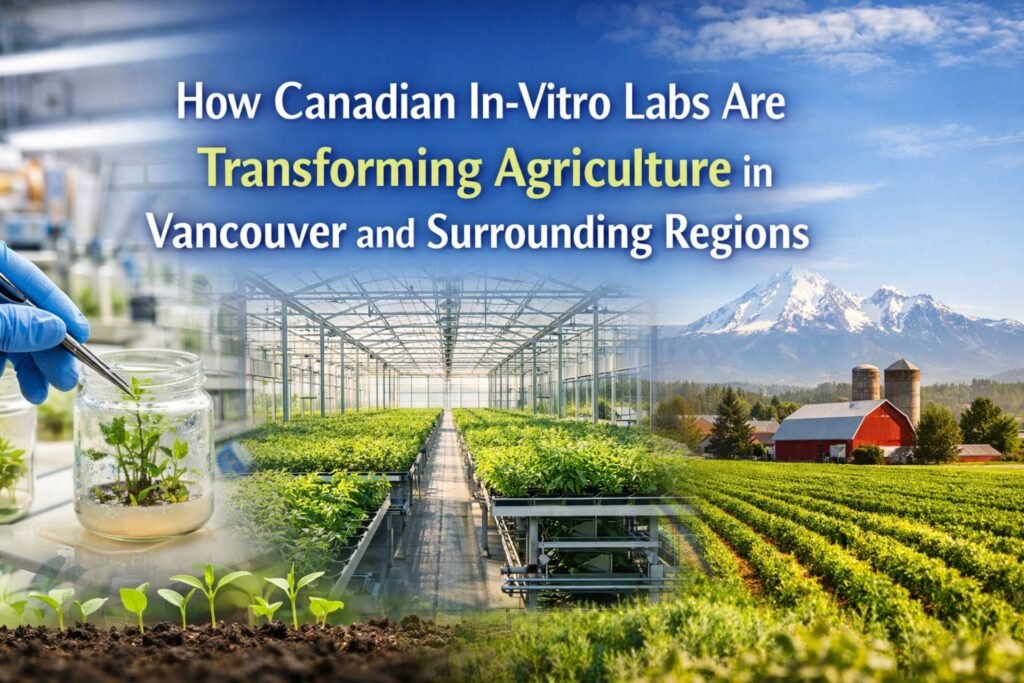
How Canadian In-Vitro Labs Are Transforming Agriculture in Vancouver and Surrounding Regions
A New Era of Precision Agriculture in British Columbia
Agriculture in Canada—especially in Vancouver and nearby regions—is undergoing a remarkable transformation. With increasing demand for sustainable farming, higher crop yields, and disease-free cultivation, modern growers are turning to advanced laboratory techniques to stay ahead. Among these innovations, in-vitro propagation stands out as a game-changing solution.
In-vitro labs are redefining how farmers, nurseries, and commercial growers produce high-quality crops. By cultivating plants in controlled environments, these labs ensure consistency, health, and scalability—three essential pillars for modern agriculture. In regions like British Columbia, where climate variability and land costs pose challenges, these technologies are not just beneficial—they are essential.
Understanding In-Vitro Technology in Agriculture
In-vitro propagation, often referred to as tissue culture, involves growing plants in sterile, nutrient-rich environments under controlled conditions. This method allows growers to produce uniform, disease-free plants at scale—something traditional propagation methods struggle to achieve.
Unlike conventional farming, where environmental factors can introduce inconsistencies, in-vitro labs eliminate many of these risks. Each plant is nurtured in a highly controlled setting, ensuring optimal growth from the very beginning.
Key Benefits of In-Vitro Propagation:
- Disease-Free Growth: Plants are cultivated in sterile conditions, reducing contamination risks.
- Uniform Quality: Each plant grows with consistent genetic traits.
- Faster Multiplication: Large quantities can be produced in a shorter time frame.
- Year-Round Production: Independent of seasonal limitations.
These advantages are especially valuable in Vancouver’s agricultural landscape, where efficiency and quality are critical for success.
Why Vancouver and Surrounding Regions Are Embracing In-Vitro Labs
Vancouver and nearby regions such as Abbotsford and the Fraser Valley are known for their thriving agricultural industry. However, challenges such as limited arable land, unpredictable weather patterns, and increasing production costs have pushed growers toward innovative solutions.
In-vitro labs address these challenges effectively:
1. Maximizing Limited Space
Urban expansion has reduced available farmland. In-vitro propagation allows growers to produce large quantities of crops in compact laboratory settings before transferring them to greenhouses or fields.
2. Climate Adaptability
British Columbia’s climate can be unpredictable. Controlled lab environments ensure stable growth conditions, regardless of external weather fluctuations.
3. Supporting High-Value Crops
Crops like berries, ornamentals, and specialty plants require precision and consistency. In-vitro techniques ensure premium quality, which is essential for both domestic markets and exports.
Boosting Sustainability Through Advanced Cultivation
Sustainability is no longer optional—it’s a necessity. In-vitro labs contribute significantly to environmentally responsible farming practices.
By producing clean and healthy plants, growers reduce the need for chemical pesticides and fertilizers. This not only lowers environmental impact but also results in safer, higher-quality produce.
Additionally, the efficiency of in-vitro propagation minimizes waste. Instead of relying on trial-and-error planting, growers can start with strong, viable plants that have a higher success rate in soil or greenhouse environments.
For more insights into sustainable agriculture practices, you can explore resources from organizations like the
🔗 https://www.agr.gc.ca (Agriculture and Agri-Food Canada), which promotes innovation in Canadian farming.
Strengthening Local Economies and Supply Chains
The rise of in-vitro labs is not just a technological advancement—it’s an economic driver. By enabling local production of high-quality planting materials, these labs reduce reliance on imports and strengthen domestic supply chains.
Economic Benefits Include:
- Job Creation: Skilled roles in laboratory operations and greenhouse management.
- Reduced Import Costs: Locally produced plants decrease dependency on foreign suppliers.
- Increased Productivity: Higher yields translate into better profitability for growers.
Regions like Abbotsford have become hubs for agricultural innovation, where modern labs and traditional farming practices work hand in hand to drive growth.
The Role of Innovation in Future Farming
As technology continues to evolve, in-vitro labs are expected to play an even greater role in shaping the future of agriculture. Integration with automation, artificial intelligence, and data analytics will further enhance efficiency and precision.
Future developments may include:
- Automated propagation systems for large-scale production
- AI-driven monitoring of plant health and growth conditions
- Enhanced genetic selection for improved crop resilience
These advancements will help Canadian agriculture remain competitive on a global scale while maintaining high standards of quality and sustainability.
Why Growers Trust Canadian In-Vitro Solutions
When it comes to reliability and quality, professional in-vitro labs provide a level of assurance that traditional methods simply cannot match. Growers benefit from:
- Consistent supply of premium plants
- Reduced risk of crop failure
- Improved overall farm efficiency
For businesses operating in Vancouver and surrounding regions, partnering with a trusted in-vitro provider can make a significant difference in long-term success.
If you’re exploring premium-quality tissue culture solutions, learn more about our offerings here:
🔗 https://canadianinvitroplants.com/
Conclusion: A Transformative Shift in Agriculture
The agricultural landscape in Vancouver and surrounding regions is evolving rapidly, and in-vitro labs are at the forefront of this transformation. By combining science, sustainability, and efficiency, these labs are empowering growers to meet modern demands with confidence.
From improving crop quality to strengthening local economies, the impact of in-vitro propagation is both profound and far-reaching. As more growers embrace this technology, the future of agriculture in British Columbia looks not only promising—but revolutionary.